The Pacific is Calling – Let’s Answer it Safely
There is an undeniable magic to Aurora Province. Tucked between the dramatic, emerald ridges of the Sierra Madre and the vast, untamed expanse of the Pacific Ocean, our home is a sanctuary for thrill-seekers, nature lovers, and anyone looking to catch the perfect wave. From the legendary swells of Sabang Beach to the serene, hidden pools of our inland waterfalls, water is life here.
But because we share our shores with the raw, powerful Pacific, loving the water means respecting its strength. Embracing the ocean means equipping ourselves with the knowledge to keep every adventure joyful, safe, and memorable.
Understanding Our Waters: The Realities of the Coast
The Pacific Ocean brings incredible beauty, but its tides are vastly different from the calm, enclosed gulfs of other islands. It features deep drop-offs, shifting sandbars, and powerful rip currents.
While exact annual figures fluctuate based on weather events and tourist volume for Aurora province, accidental drowning and submersion cause an average of 3,000 to 3,600 deaths annually in the entire Philippines, equating to roughly 10 Filipinos losing their lives each day. It is a leading cause of unintentional injury-related deaths, with children and adolescents particularly vulnerable, accounting for over a third of all drowning fatalities. Local disaster risk reduction management offices (PDRRMO) note that accidental drownings remain a critical concern, particularly during long weekends, summer peaks, and sudden weather shifts. In coastal provinces like Aurora, these incidents occur due, by and large, to a lack of familiarity with local current patterns, swimming in non-designated zones, or underestimated undertows.
How to Spot a Rip Current and Assess Sea Conditions
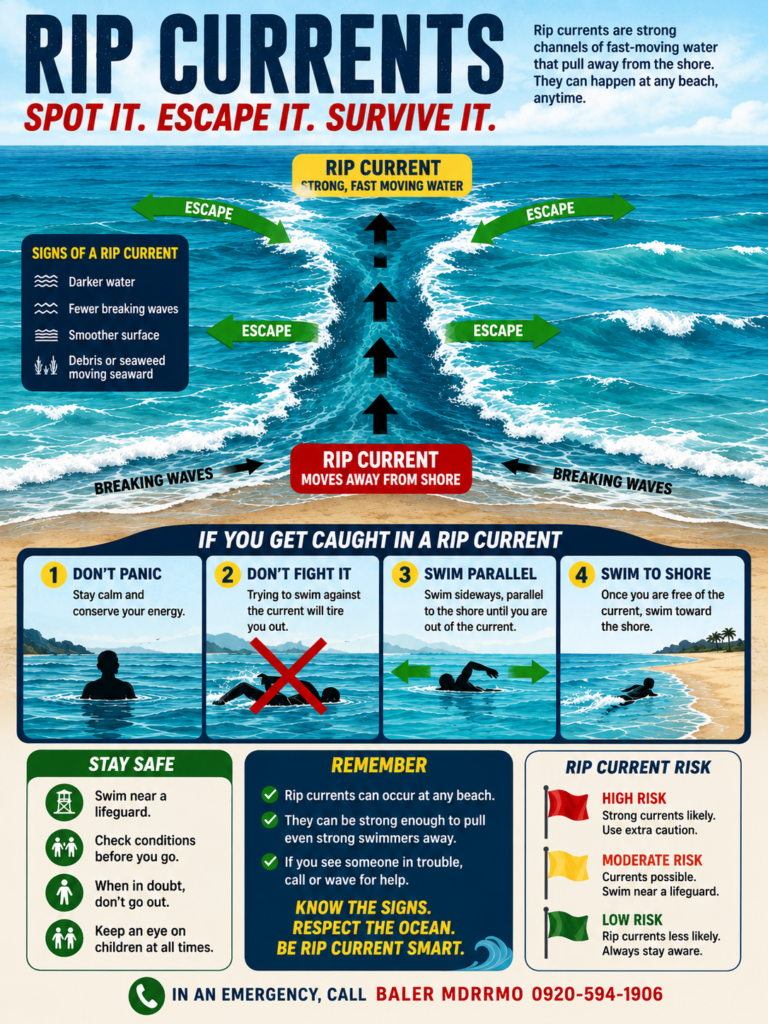
Before you even dip your toes in the water, take five minutes to study the sea. Knowing how to read the Pacific is your first and best defense against rip currents (often called rip tides or undertows).
How to Spot a Rip Current from the Shore:
- The Gap in the Waves: Look for a break in the incoming wave pattern. A zone where waves are breaking on the left and right, but a calm-looking strip in the middle exists, is often a rip current carrying water out to sea.
- Discolored Water: Because rip currents aggressively channel water away from the beach, they churn up sand and debris. Look for a river-like column of water that looks churned, muddy, or foamier than the surrounding sea.
Different Surface Texture: Keep an eye out for a distinct patch of water that looks choppy, rippled, or suspiciously calmer than the rolling waves around it.
Assessing Sea Conditions (Identifying High-Risk Days):
- The Flag System: Always check the local LGU or resort beach flags. A Red Flag means high hazard—stay out of the water completely.
- Heavy Swells and Strong Offshore Winds: If the waves are breaking exceptionally hard or fast, or if strong winds are blowing from the land out to sea, the volume of water rushing back out increases exponentially, creating ideal conditions for flash rip currents.
- Rapidly Changing Tides: Pay extra attention during the transition from high tide to low tide. As the tide pulls back, the water drains away from the beach with much greater velocity through deeper channels and sandbars.
Survival Guide: What to Do If Caught in a Rip Current
If you feel a sudden, powerful pull dragging you away from the shore, do not panic. Rip currents do not pull you underwater; they only push you away from the beach. Understanding this keeps you calm enough to survive.
- Do NOT Swim Against the Current: Your natural instinct will be to swim straight back to shore. Fighting a rip current will quickly exhaust you, which is the primary cause of drowning.
- Float and Breathe: Conserve your energy. Stay calm, keep your head above water, and let the current carry you out slightly until its strength dissipates.
- Swim Parallel to the Shore: Once the pull weakens, swim sideways—parallel to the beach—to escape the narrow channel of the rip current. Once you are in the area where waves are breaking normally toward the shore, use those waves to help push you back to land.
- Signal for Help: If you cannot swim out of it, face the shore, wave your arms, and shout for help while staying afloat.
Rescue and First Aid: Be the Guardian
If an emergency does occur, acting quickly, calmly, and correctly can save a life. Here is the step-by-step framework for a water rescue and first aid tailored specifically for a rip current scenario.
1. The Rescue: Think Smart, Stay Safe
The number one rule of water rescue is: Do not become a victim yourself. Desperate, drowning swimmers will instinctively pull their rescuers under. Always follow this sequence:
- Shout for Help: Immediately alert lifeguards, bystanders, or call the local emergency hotline.
- Reach or Throw, Don’t Go: Before jumping in, try to reach the person with a long object (like a surfboard, bamboo pole, or branch) or throw them something that floats (like a cooler, life ring, or even an empty plastic jug).
- Row: If they are too far out, use a kayak, boat, or surfboard to get to them rather than swimming out unprotected.
2. Immediate First Aid on Shore
Once the person is safely back on dry land, check for responsiveness and breathing.
- If they are breathing: Turn them onto their side into the recovery position. This keeps their airway clear and allows any swallowed water or vomit to drain safely. Keep them warm with a dry towel or blanket.
- If they are NOT breathing: Every second counts. Start CPR immediately.
- Open the Airway: Tilt their head back slightly and lift the chin.
- Give 5 Rescue Breaths: Unlike cardiac arrests on land, drowning victims desperately need oxygen. Pinch their nose and deliver 5 initial rescue breaths into their mouth.
- Begin Cycles of 30 Compressions and 2 Breaths: Place your hands in the center of their chest and push down firmly and fast (100–120 compressions per minute). Alternate 30 compressions with 2 rescue breaths.
- Do Not Attempt to “Drain” the Water: Do not waste time pressing on their stomach or turning them upside down to get water out. Focus entirely on continuous CPR until medical professionals arrive.
A Shared Horizon
Aurora’s waters belong to all of us—the surfers chasing the horizon, the children playing on the shoreline, and the travelers seeking inspiration. By looking out for one another, learning the signs of the sea, and prioritizing safety, we honor the pristine beauty of our province and ensure that every sunset brings the promise of a safe, bright tomorrow.